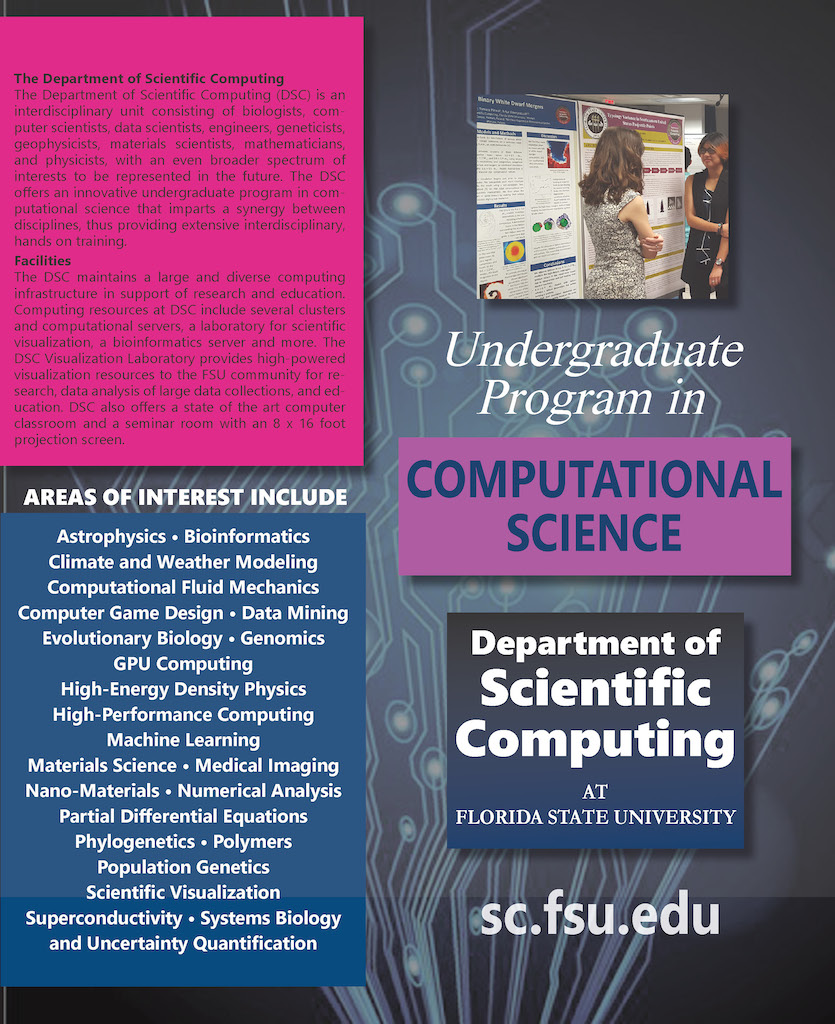
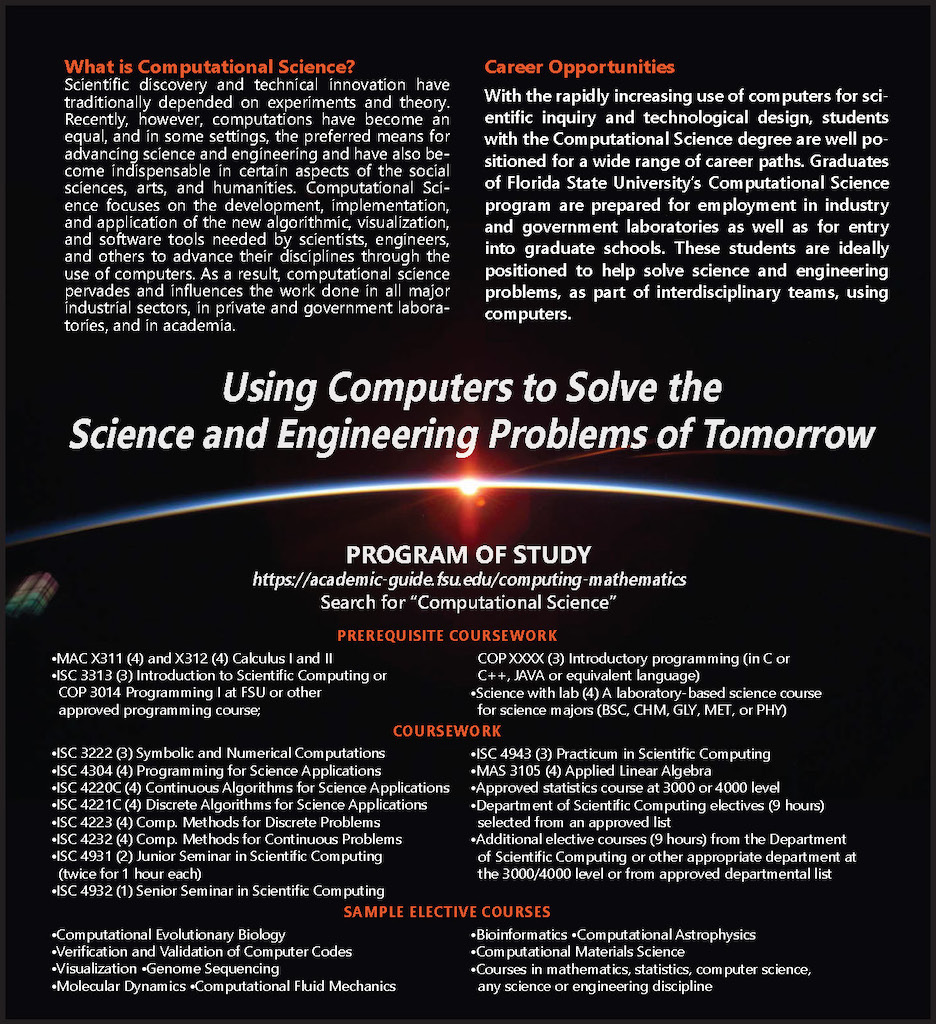
The Department of Scientific Computing offers an innovative B.S. degree program in Computational Science. This degree program should be of interest to and is well suited for those who like working on computers and who ordinarily would also be interested in any of the mathematical sciences (mathematics, computer science, statistics), or any of the natural sciences (biology, chemistry, physics, geological sciences, ...), or any engineering discipline. It should be of special interest to students interested in two or more of these areas. Students majoring in Computational Science will learn how to develop and apply new computational tools to solve science and engineering problems.
The Department of Scientific Computing is the focal point of computational science activities at FSU. Computational science involves the invention, implementation, testing, and application of algorithms and software used to solve large-scale scientific and engineering problems. The Department provides a venue for innovative research and education in computational science. Our faculty come from a wide variety of traditional mathematical, scientific, and engineering disciplines who are primarily interested in developing knowledge and tools for computational science and applying those tools to the solution of problems in a variety of applications.
Please note that computational science is different from computer science. At the risk of oversimplifying things, one can say that computer science is about the science of computers whereas computational science is about the use of computers to solve science and engineering problems.
The undergraduate Minor and B.S. degree programs in Computational Science, along with the already established Master's and Ph.D. programs, trains students in computational science by providing them with a mix of theory and practice, including substantial hands-on experience in the deployment and use of algorithms for solving scientific and engineering problems.
Questions should be sent to
- B.S. degree program in Computational Science
- Minor degree in Computational Science
- Undergraduate Courses